


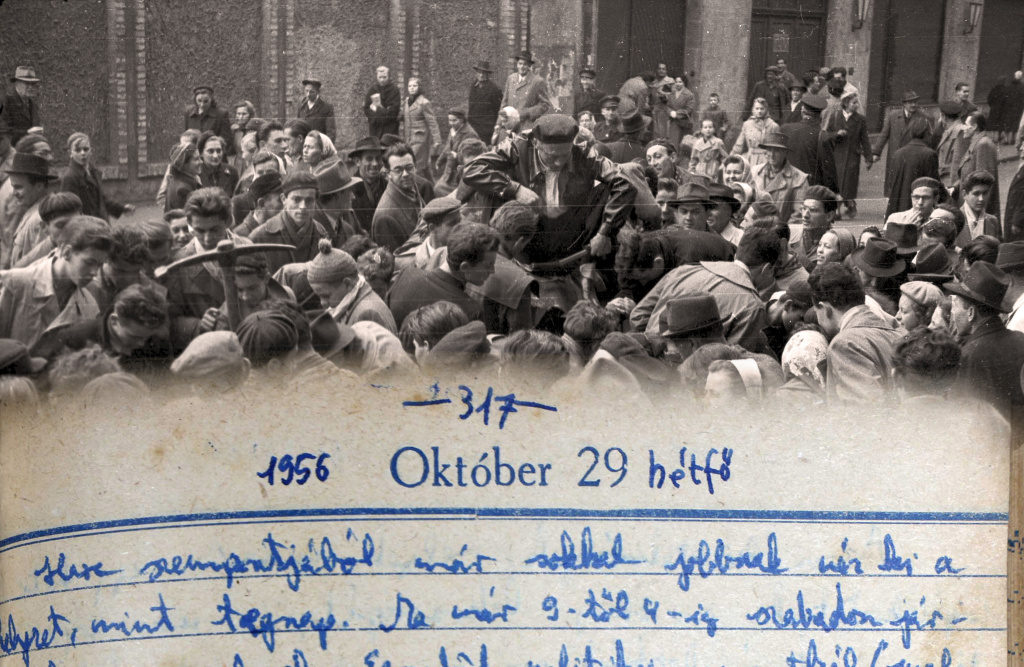
János Geszti – who later became a well-known figure in Brazilian musical life and music education under the name Ian Guest – was 16 years old in October 1956. He lived in Budapest at 28 Katona József Street with his parents and siblings – his younger brother Gábor and his younger sister Juli. His father, György, was a concert pianist, while his mother, Klára, taught at a university. János began keeping a diary in September 1954, recording the events of his everyday life. After the outbreak of the Revolution, alongside his personal diary he also kept a separate chronicle of events.
To mark the 70th anniversary of the Revolution, from 20 October to 5 November we will publish, day by day, the diary entries Geszti János wrote on each corresponding date, bringing this remarkable and still highly relevant historical document to a wider audience.
The manuscript of the diary
Personal Diary
In terms of the fighting, the situation already looks much better than yesterday. Today people were free to go out from 9 until 4. It is only from a political point of view — which is of primary importance — that events are causing particular excitement. Everyone is in the greatest dilemma and is constantly searching for sources of information; I saw this for myself when, despite the ban, I noticed fairly large groups of people in the streets. They are mainly reading notices pasted up on the walls, produced on the revolutionaries’ typewriters. With various one-sentence reports and slogans, the revolutionaries are trying to win the people over to their side. In addition, the “new” Kossuth coat of arms has been sewn onto flags and pasted onto walls in many places.
In the morning I went on two walks with Gábor: one along the Boulevard as far as Rudas László Street, and the other to Grandmother and Grandfather’s. On the first walk we saw a great many smashed shop windows, behind which valuable goods still lay untouched. Nor did the shot-down red stars and the missing coat of arms on the façade of Nyugati Railway Station escape our attention. The glazing of Nyugati’s iron hall, incidentally, has been riddled with bullets.
There is an enormous amount of dirt and rubbish in the streets. I spent the entire afternoon reading Thomas Mann’s excellent Confessions of Felix Krull.
Continuation of the diary entries
7 10 The provincial Hungarian cities are more or less satisfied with the government’s decisions. In Miskolc, however, the strike is still continuing.
8 30 The leading article in Pravda, the official newspaper of the Soviet Communist Party, deals in detail with the events in Hungary deals in detail with the events in Hungary: the Revolution was progressive in spirit and fought successfully for the Hungarian people and the independence of the nation.
10 15 I was down in the street with Gábor. We walked along the Boulevard as far as Rudas László Street, where the queues are already much shorter. Along the Szent István Boulevard section of the Boulevard, the shop windows and buildings are intact. Around Nyugati, however, every shop window and windowpane is broken, and Nyugati’s glass hall has been riddled with bullets. In most of the shop windows the valuable goods are still lying untouched behind the broken glass. No one is stealing. There are enormous numbers of tanks, armoured vehicles, jeeps, ambulances, artillery pieces and anti-aircraft guns in the streets; some of them are lying overturned. Tram wires are hanging down all along the street. Soldiers and policemen stand in every doorway and on every corner along the Boulevard, but mainly Soviet soldiers. There are armoured vehicles on the pavements as well. The streets are disgustingly dirty and littered, and full of pedestrians. Everyone is excitedly discussing politics. In some places today’s Szabad Nép — the daily newspaper of the MDP (Hungarian Working People’s Party, the ruling communist party) — has been posted on the wall, and many people are reading it. Newspapers are still not really available to buy.
10 16 Radio: The United Nations Security Council has been convened at the request of the Western great powers. At this meeting they put to a vote whether the UN should meet to discuss the Hungarian question. The Soviet Union is opposed, Hungary is also opposed; the Western countries want it convened. Yugoslavia abstained. For the time being, the matter has been adjourned.
10 32 Orders from the Minister of Defence and the Minister of the Interior on the radio. Government decrees must be carried out. The official form of address is bajtárs (“comrade-in-arms”), rather than the communist form elvtárs (“comrade”). For the time being, police officers and soldiers should wear a ribbon in the national colours on their caps instead of the coat of arms.
11 06 Radio: In many places even the most upright Communists, who have demonstrated firmness of principle, are being elected to the councils.
11 07 Szabad Nép criticises the Pravda article. According to Szabad Nép, the Hungarian Revolution is not an anti-popular adventure but a legitimate demand, contrary to the Pravda article. Pravda claims that the counter-revolution supported by imperialism has collapsed. Szabad Nép, by contrast, hits back that the uprising has indeed won. Pravda is lying.
13 03 Gábor and I were at Grandmother’s. What we saw on the way hardly suggests that people are satisfied. Everywhere there are typed notices in which the insurgents write that they are not Fascists, assassins or looters; they are rising only in the name of workers who have been made to labour like animals for twelve years. Another typed notice, posted in many copies, states that Béla Kovács, Minister of Agriculture, has left the government and said that he will not negotiate with Imre Nagy. He is now in Pécs. Another notice informs us that the insurgents have won completely in Győr. Everywhere there are signs saying: “Long live free Győr.” In addition, Győr and Miskolc now have their own radio stations as anti-government cities. The wavelengths of the two stations are written on many notices… Meanwhile the streets are simply swarming with Soviet soldiers.
13 39 As I have already written, there is a strike in Miskolc, and it has spread throughout the country. In Budapest too, there are signs in the streets reading “Death to strikebreakers.”
14 23 Radio commentary on the new Kossuth coat of arms, which has already been displayed in many places.
14 55 I heard the joyful news that Mihály Farkas and Vladimir Farkas have been killed.
15 04 The Budapest Municipal Council has renamed Stalin Road Free Youth Road, Stalin Bridge Árpád Bridge, and Stalin Square Dózsa György Road.
15 06 Radio: Recently only the most important telephone lines have been operating (ours among them), but this afternoon everything will probably be reconnected.
15 35 Actress Ági Mészáros, a recipient of the Kossuth Prize, made a statement on the radio. She hopes that the Hungarian nation will finally become independent and that the Soviet troops will be removed. She is willing to continue her acting career only if this happens within days.
16 06 The city of Győr has sent delegates to Budapest to check on events here. The delegates from Győr are satisfied with the situation. (Radio.)
16 41 Hungarian writers speak on the radio, “in the language of our literature”: a poem by László Benjámin. One line from it: “Ernő Gerő knows only how to kill.” A piece by Zoltán Zelk is read out. A piece by Ferenc Karinthy: the Soviet troops must leave the country. Finally, a poem by István Ősi is read out: “So we can be like this too?”
17 20 The radio reads out an announcement from the Ministry of Defence: those still resisting should hand their weapons over to the Hungarian Army, which is replacing the Russians. Within 24 hours from now, the withdrawal of Soviet troops from Budapest will begin.
18 57 According to Austrian youth radio, the Hungarian uprising has grown far beyond the country’s borders, and for this reason people on all sides are willing to help the Hungarians. In Austria, ten thousand young people queued to give blood; eventually the police had to prevent even more people from registering at the blood-donation station. The Austrians are very decent.
20 03 According to reports, Soviet troops are continuing to enter Hungary. In many foreign countries there are demonstrations against the Communists and the Soviet Union; in Rome, for example, there was a major anti-Soviet demonstration prompted by the events in Hungary.
20 08 I forgot to write that this morning the radio announced the telephone number at which Imre Nagy could be reached.
20 12 Radio: Lajos Bebrits, Minister of Transport and Posts, has resigned. Someone called Csanády has become minister in his place.
20 58 Radio: This evening the Hungarian Army began replacing the Soviet troops, first in District VIII, so that the Soviet soldiers can withdraw from the country.
The photograph used as the basis for the opening image: fortepan.hu, 318782. (donated by Mihály Bogdán)