


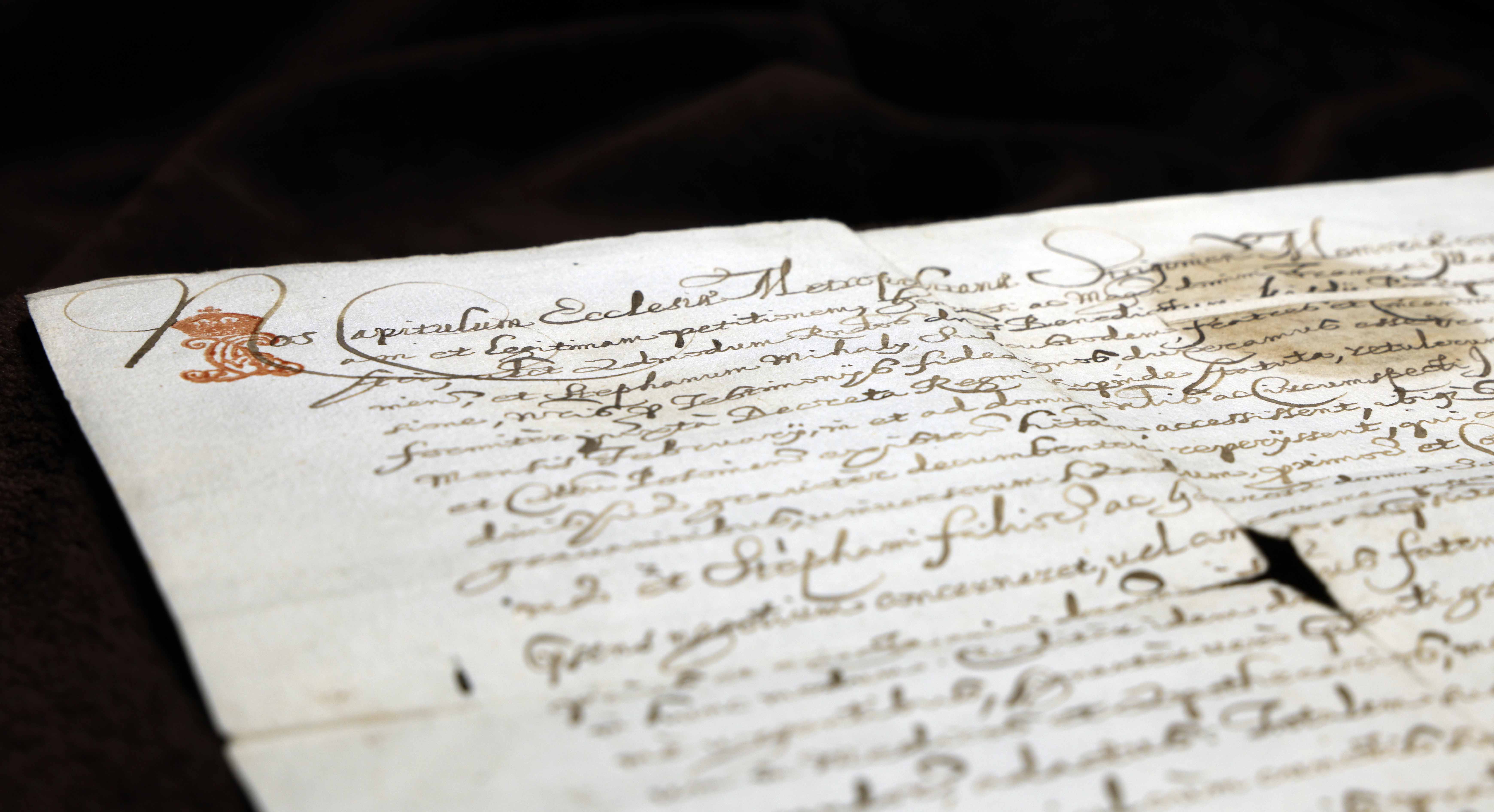
At an auction in the autumn of 2026, the Hungarian Heritage Archives Foundation acquired a charter issued by the Chapter of Esztergom in 1634. The document is particularly noteworthy for the number of prominent figures of the period who appear in it. Foremost among them is Ferenc Illésházy, whom the delegates of the Chapter found seriously ill and confined to his bed in the house of a citizen of Nagyszombat (today Trnava, Slovakia).
Ferenc was the nephew of no less a figure than István Illésházy, Palatine of Hungary from 1608 to 1609. Although, by the Palatine’s decision, Ferenc did not share in his uncle’s vast inheritance, he ultimately became the progenitor of the longest-surviving branch of the Illésházy family. His sons, István and Tamás—both also mentioned in the charter—were elevated to the rank of baron in 1646 and 1649 respectively, while Ferenc’s great-grandson Miklós was created a count in 1678.[1]
In the charter, Ferenc pledged his estate of Középbő in Nyitra County (today Behynce, Slovakia) as security for a loan. He explained that his serious illness could only be overcome by spending considerable sums on physicians, apothecaries and medicines. In his hour of need, Mihály Vízkelethy of Szeptencújfalu, a former vice-palatine who had been elevated to the rank of baron together with his father in 1608, came to his assistance with a loan of one thousand Hungarian florins.
Even the two delegates of the Chapter were men of considerable distinction. Benedek Kisdi, Provost of St George at Esztergom-Zöldmező, later became Bishop of Szerém, Várad and finally Eger; among his lasting achievements was the foundation of the Academy of Kassa (today Košice) in 1657. His companion, canon István Mihály, later attained the titular abbacy of Pécsvárad.
Ferenc Illésházy evidently recovered from his illness, thanks to the timely loan and the physicians of Nagyszombat: he lived for another seven years, dying on 13 January 1641.[2]
This time, however, it is not primarily the contents of the charter that command our attention, but its provenance. Stamped over the initial letter N of the document is a familiar red crowned ligature containing the letters AC—Archivum Camerae or Archivum Camerale, the Archives of the Hungarian Chamber. The same stamp can be found on thousands of documents from the Chamber now preserved in the National Archives of Hungary. Turning the charter over reveals another familiar mark: an old reference written in red ink, N. R. A., standing for Neo-regestrata Acta (“Newly Registered Records”), one of the best-known and undoubtedly one of the richest archival fonds of the Hungarian Chamber. These markings establish beyond doubt that the charter once belonged to the National Archives or one of its predecessor institutions. But when did it leave?
Thanks to the staff of the National Archives of Hungary, we were able to discover that in the place where the charter should have been preserved under its former reference—Neo-regestrata Acta, fasc. 534, no. 27—there is instead a removal slip recording the circumstances under which the document was taken from the collection. According to this slip, the original charter was handed over to the Royal Director of Legal Affairs on 15 December 1841. The official who signed the slip, “Wezinger”—Károly Wezinger, registrar—even recorded the reference numbers of the instructions under which the document had been retrieved. Further research may eventually reveal why Ferenc Illésházy’s declaration was required and perhaps even which other records left the Archives of the Hungarian Chamber together with it. It is probably not far from the truth to suppose that the Royal Director of Legal Affairs was investigating the legal status of certain Illésházy estates. In the summer of 1838, Count István Illésházy had died, bringing the centuries-old family to extinction in the male line. The Treasury would therefore have had good reason to investigate whether the Crown had any legal claim to part of the family’s enormous landed estate. One thing, however, is certain: for the next 185 years, the charter never returned to its proper place. It may have become lost among the records of the Royal Directorate of Legal Affairs, or perhaps it was later discarded. From there, it must have followed an eventful path, passing through numerous hands before finally appearing on the antiquarian market in 2026. Now, after 185 years, it is finally returning to the place where it belongs.
Abstract of the Charter:
5 February 1634. The Chapter of Esztergom records that, at the request of Ferenc Illésházy (gen. et magn.), it delegated Benedek Kisdy, Provost of the Church of St George at Esztergom-Zöldmező, and succustos István Mihaly, to witness and hear the following declaration. Upon their return, they reported under oath that on 5 February they had gone to the house of János Chereödy (nob. et circumsp.) in the city of Nagyszombat, where they found Ferenc Illésházy seriously ill. Before the delegated witnesses, and assuming responsibility for all his relatives and especially for his children—Tamás, István and Zsófia (gen. dom.), wife of Ferenc Ochkay (egr.)—Illésházy, after mature deliberation, made the following declaration. Compelled by his present necessities, and particularly by the expenses arising from his serious and dangerous illness—including payments to physicians and apothecaries, the cost of medicines, and other expenses necessary for his recovery—he pledged his entire small estate (possessiuncula) called Közepső Behenicz in Nyitra County, together with all its revenues and appurtenances, to Mihály Vizkelethi of Septincz Uyffalu (magnificus) and his heirs for the sum of one thousand Hungarian florins, which he actually received in the presence of the witnesses. The pledge was made on the condition that Ferenc or his heirs might redeem the estate at any time upon repayment of the same sum. The pledgee and his heirs would nevertheless remain entitled to harvest crops already growing within the boundaries of the estate and to collect outstanding dues. Ferenc undertook warranty for the transaction. Datum in festo Agathae virg. et mart., 1634.
The charter survives on paper, torn along its folds, with a paper-covered seal on the reverse and the stamp of the Archives of the Hungarian Chamber impressed over the initial letter of the text. Beneath the text, on the right, appears the notation “Lecta.” In the lower right-hand corner of the reverse, a contemporary hand wrote: Pro magnifico domino Michaele Vizkelethy. Another, approximately contemporary hand added: Illeshazi Ferencz, Keözepse Behenicz. Former archival references: Illésházy Elen. II. nr. 8 and N. R. A. fasc. 534. no. 27.
Tibor Neumann
[1] On the genealogy of the family, see István Fazekas, “Az Illésházy család XVII. századi leszármazása,” Turul 65 (1951–1992), 13–17. Genealogical tables currently available online and based on Iván Nagy’s genealogical handbook (for instance, https://genealogy.euweb.cz/hung/illeshazy.html) contain errors specifically concerning Ferenc and his sons.
[2] The date of his death is known through the kind communication of Béla Hanák.