


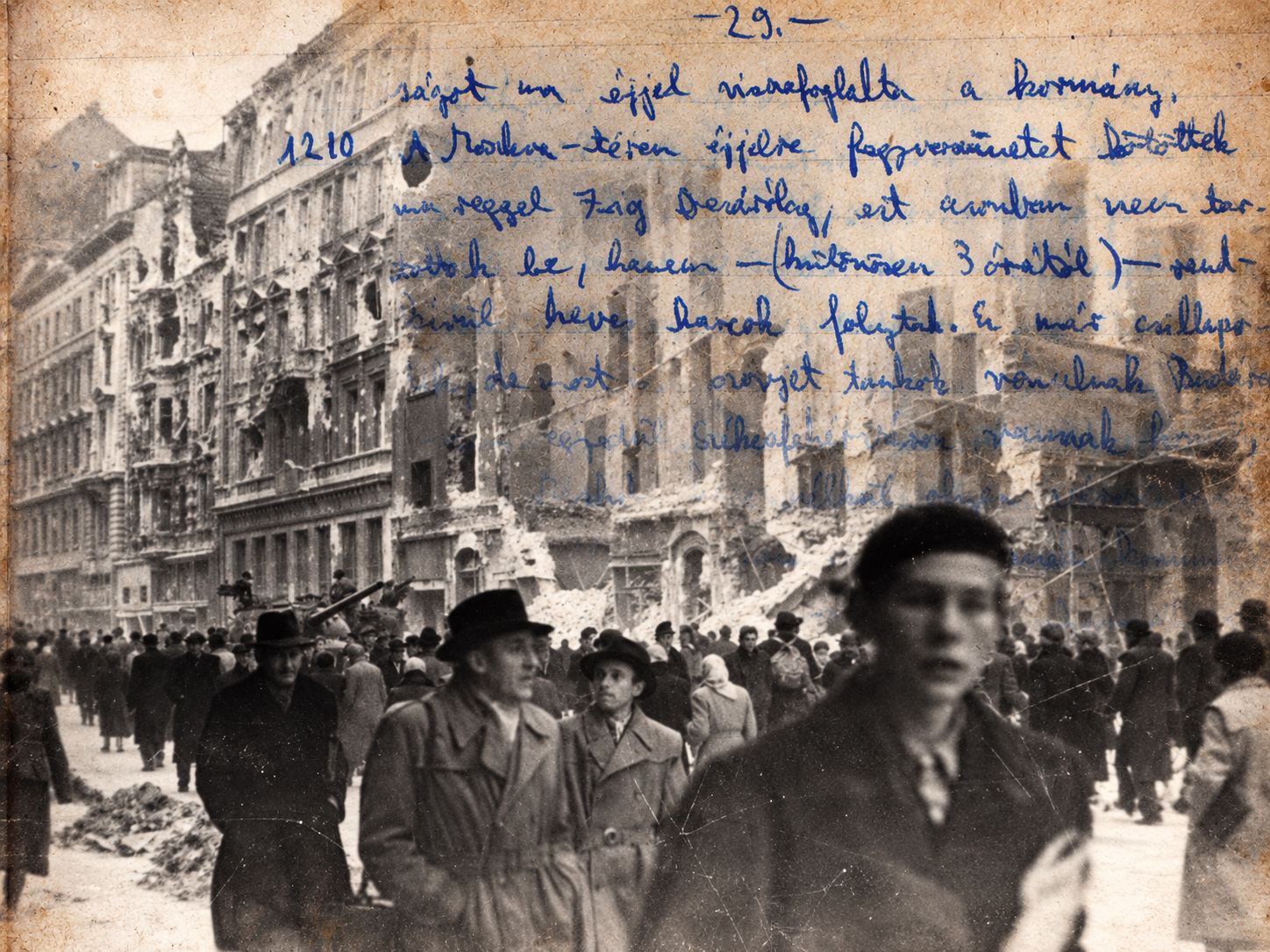
As the first joint preservation project of the Hungarian Heritage Archives Foundation and the Hungarian Roots & New World Dreams Heritage Program, we have digitized a remarkable collection of Hungarian historical documents preserved in Brazil. The several thousand pages of handwritten diaries kept by János Geszti – a musician and music educator later known in his new homeland as Ian Guest – document the life of a Hungarian emigrant from the second half of the 20th century onwards. One particularly valuable part of the diaries was written during the Hungarian Revolution of 1956: János was sixteen at the time and recorded the events unfolding around him in remarkable, almost minute-by-minute detail.
A Hungarian Family’s Journey to Brazil
János Geszti was born in Budapest in 1940. His parents, Klára and György, met at the Ferenc Liszt Academy of Music and married in 1938. A few years later, the war tore the Jewish family apart. György became a prisoner of war, while Klára survived the Holocaust with her young son by living under a false name and hiding in Pusztamiske. The family was reunited in Budapest in 1945. Their second son, Gábor, was born a year later, followed by a daughter in 1953.
The next turning point in their lives came with the 1956 Revolution. Sixteen-year-old János fled to Austria with relatives on 23 December 1956. His parents and siblings followed on 7 January 1957. Reunited in Austria, the family travelled via Genoa to Brazil with the support of HIAS, a Jewish aid organization. They arrived in Rio de Janeiro on 11 May 1957.
The family built a new life in Brazil without losing touch with their Hungarian roots. Music and the arts continued to play a central role in their lives. In Brazil, János adopted the name Ian Guest and became a well-known figure in Brazilian music and music education. In 1987, he founded the CIGAM music school in Rio de Janeiro and also played an important role in introducing Hungarian musical culture and the Kodály method to Brazil.
The Story Behind the Diaries
Another, very different record of János Geszti’s life has also survived: several thousand pages of handwritten diaries. They were preserved in Brazil by his brother Gábor and his family. It was János’s niece, Laura Araujo Geszti, whose family history research drew attention to their significance.
Over many years, Laura pieced together the story of her family, while members of the older generation spoke little about the war, the revolution, their escape, and emigration. Through old photographs, letters, memoirs, and diaries, the family’s past gradually came into focus. She has written their story for the forthcoming Brazilian volume of the Hungarian Roots & New World Dreams book series, drawing on János Geszti’s diary as well. In the summer of 2026, Dr Sarolta Kóbori, who leads the Brazilian project of the Hungarian Roots & New World Dreams Heritage Program, was able to see the thousands of pages of diaries in person during a visit to Brazil. This led to the cooperation that eventually brought in the Hungarian Heritage Archives Foundation and made the digitization of the diaries possible. As the first joint preservation project of the Foundation and the Heritage Program, we digitized several thousand pages of János Geszti’s diaries in Hungary in the autumn of 2026, helping to ensure that this remarkable source is preserved for the long term and made available for future research.
1956 Through the Eyes of a Sixteen-Year-Old
Some of the most fascinating parts of the diary are the entries János Geszti wrote in the autumn of 1956. He experienced the Revolution in Budapest at the age of sixteen and recorded what was happening around him in extraordinary detail. His notes are not recollections written decades later, but personal accounts written as the events themselves unfolded.
We also know what happened next. Two months later, János was recording his own escape. At 8:20 a.m. on 23 December, he left Budapest. In his diary, he described the uncertainty of the journey towards Austria and the moment he crossed the border.
As the 70th anniversary of the Revolution approaches, we would like to share this remarkable and still deeply relevant historical record with a wider audience. On the Hungarian Heritage Archives Foundation’s website, we will follow the events through János Geszti’s 1956 diary, beginning in the days before the Revolution: from 20 October to 4 November, we will publish his entries on the corresponding dates on which they were originally written.
Seventy years later, we will be able to see those days through the eyes of a sixteen-year-old boy in Budapest: from the days immediately before the Revolution to the events of 23 October and the dramatic days that followed, recorded almost minute by minute.
János Geszti’s diaries are a powerful example of the exceptional historical sources that may still survive in family collections around the world. We hope that through the partnership between the Hungarian Heritage Archives Foundation and Hungarian Roots & New World Dreams, we can bring more such sources to light in the future and work together to ensure their long-term preservation.
Réka Bakos and Zsolt Podhorányi
Photo used for the opening image: Fortepan.hu, 238057. Donor: Ambrus Bor.