


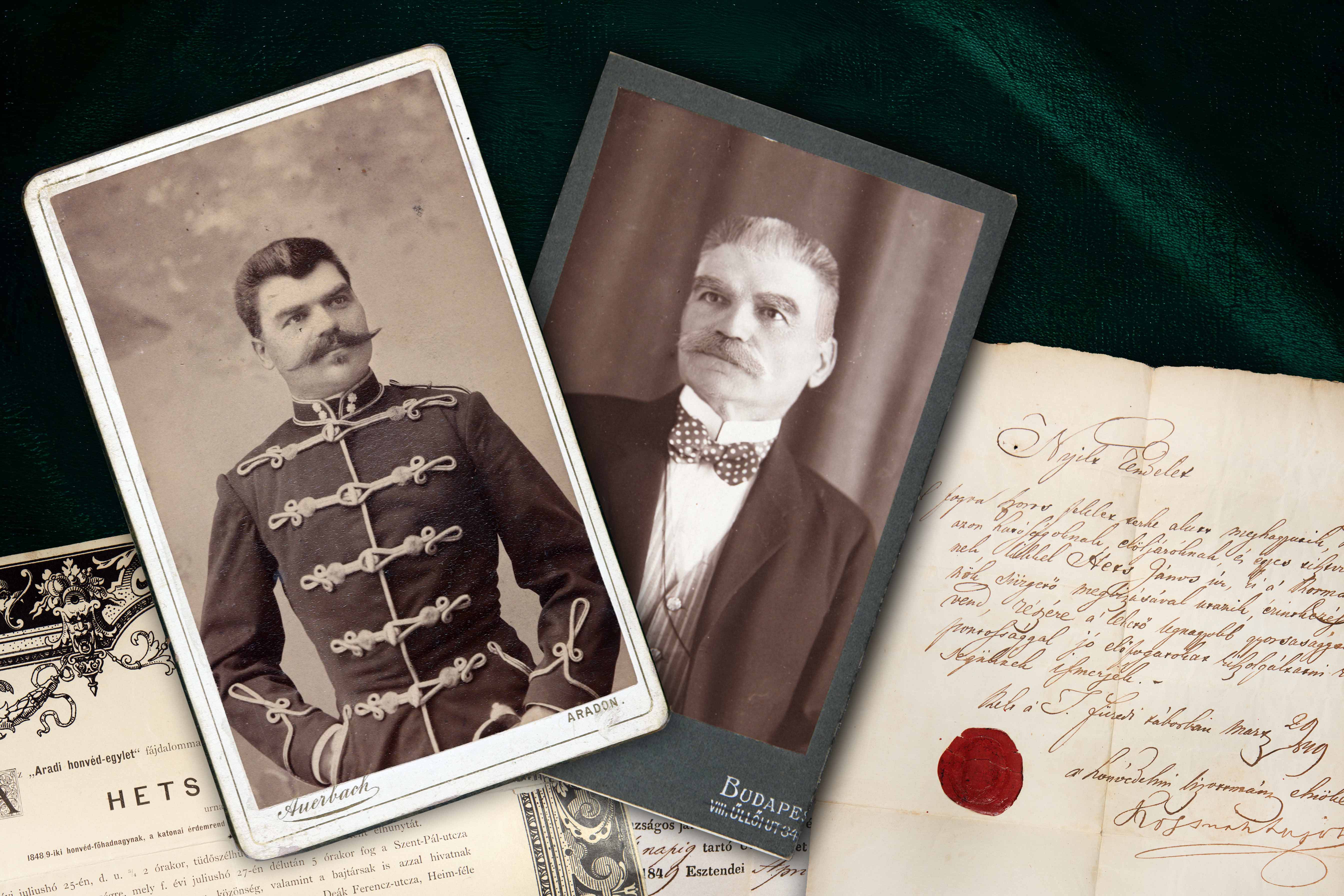
Military papers surviving from the Hungarian War of Independence of 1848–1849 generally belonged to individuals of higher military rank, such as generals or field officers, while those of lower rank typically preserved only one or two documents relating to their military careers. In this respect, the collection of papers belonging to János Hets(ch), born on 9 May 1823 in (Galga-)Hévíz, is a refreshing exception, as his surviving documents make it possible to trace almost his entire military career.
Hets graduated from the Episcopal Lyceum in Vác in 1840, after which he worked as a trainee and clerk on various Esterházy estates in western Hungary, resigning from his position on 25 October 1848.
On 10 November, he was commissioned as a second lieutenant in the 47th Honvéd Battalion, formed in Zala County, with his rank and pay backdated to 1 October. In February 1849, he was promoted to first lieutenant. On 29 March 1849, Lajos Kossuth, President of the National Defence Committee, dispatched him to Komárom together with Sándor Podrugács, a first lieutenant in the 28th Honvéd Battalion, promising that “if they faithfully carried out their assignment, they would be handsomely rewarded”. Of the two officers, Hets arrived in Komárom on 5 April and Podrugács on 8 April. On 22 April, Government Commissioner Miklós Puky issued both officers with certificates confirming the successful completion of their mission. On 29 April, they reported to Kossuth in Debrecen, who offered them promotion, but both requested instead the Third Class of the Hungarian Military Order of Merit. Kossuth therefore wrote on their behalf that same day to Lázár Mészáros, Acting Minister of War, and they received the decoration the following day. Hets subsequently returned to his unit, in whose ranks he fought for the remainder of the War of Independence as part of the I Corps, laying down his arms on the fields of Szőllős on 13 August.
On 26 September 1849, he was granted permission to leave Arad for Dombóvár. On 7 February 1850, he was conscripted into the 49th Infantry Regiment, but was granted leave as early as 1851 and was finally discharged on 31 December 1856. In 1867, he was a member of the Arad County Honvéd Veterans’ Association. He later became an insurance inspector, a member of Arad’s municipal governing body, and president of the Arad City Honvéd Veterans’ Association. He died in Arad on 25 July 1886.
His collection of papers includes the order commissioning him as a second lieutenant, signed by Minister of War Lázár Mészáros; a leave permit issued by Lieutenant Colonel Lajos Kazinczy (the fifteenth Martyr of Arad), dated 31 January 1849 at Tiszacsege; a medical certificate issued on the same day and at the same location; Kossuth’s order of 29 March concerning his mission to Komárom (in the handwriting of János Rákóczi); his passports issued at Tura on 1 April and at Ipolyság on 3 April; a previously unknown printed proclamation dated 4 April, issued by Miklós Puky, Government Commissioner at Komárom; an open order issued by Major General Richard Guyon on 22 April, authorising Hets and Podrugács to travel to Debrecen; the certificate dated 30 April 1849, also signed by Mészáros, awarding him the Third Class of the Hungarian Military Order of Merit; his discharge certificate issued at Sankt Pölten on 15 January 1857; his Honvéd Veterans’ Association membership certificate dated 1 November 1867; his service record compiled in 1876, which allows both his military and civilian careers to be traced; and finally, among numerous other documents, his death notice dated 26 July 1886, together with three photographs.
The collection of papers, which had lain concealed behind a false ceiling in the Budapest apartment of János Hets’s descendants for nearly eight decades awaiting rediscovery, was donated by the foundation to the Ministry of Defence’s Institute and Museum of Military History.
Róbert Hermann