


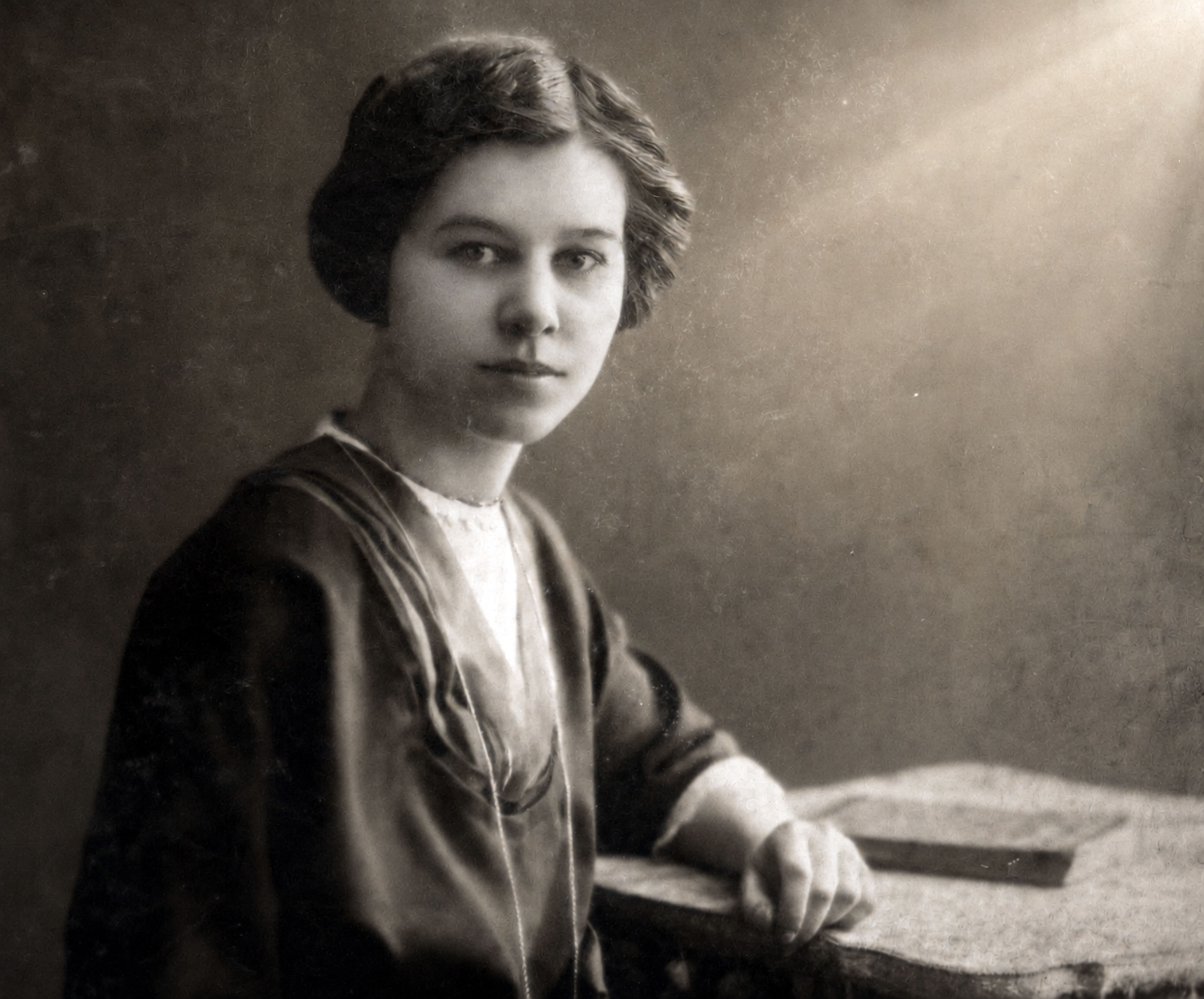
At one of the spring 2026 auctions, the Hungarian Heritage Archives Foundation purchased a small noble family archive contained in a banana box. It became clear already during the preliminary inspection that the completely unarranged collection could hardly be described as “sensational.” Nevertheless, we considered it worthy of preservation because of its significance for local history. Following the successful bid, however, one surprise followed another during the arrangement of the documents. In the end, the banana box of records developed into a “document rescue pilot project” that yielded valuable experience (for a detailed account of the project, see here).
The collection of documents was identified as the estate of Franciska Péterffy (1879–1961). Franciska came from a lesser noble family of Nemesgulács, formerly in Zala County and today part of Veszprém County. In addition to the papers of the Péterffy family and their relatives, the Eőry family, her estate also included several charters belonging to a number of noble families of the Balaton Highlands (including the Dobosy and Nagy families, landowners at Szentantalfa and Diszel). Dating predominantly from the eighteenth and nineteenth centuries, these documents constitute valuable sources for the local and family history of the settlements of the Tapolca District.
The most remarkable part of the estate is the documentation relating to the so-called Belgian Royal Inheritance Case. Franciska Péterffy was one of the leading figures in the struggle that took place between the 1910s and the 1940s, during which several families, predominantly of lesser noble origin from Transdanubia, sought to obtain a share of the Belgian royal private fortune, allegedly worth several billion gold francs, on the basis of the purported provisions of the wills of Queen Marie Henriette of Belgium (d. 1902), born a member of the House of Habsburg-Lorraine, and her husband, King Leopold II of Belgium (reigned 1865–1909). According to contemporary reports, the inheritance extended not only to movable and immovable property in Belgium but also to the revenues of the gold and diamond mines of the Belgian Congo. According to the story invented by unknown individuals, the enormous inheritance of Katalin Horváth of Szentgyörgy, who lived at the turn of the seventeenth and eighteenth centuries, passed in its entirety to the descendants of her second husband, László Esterházy, among them the Belgian queen, while the descendants of her first husband—including Franciska Péterffy—received no share of it. For this reason, the queen was said to have wished to compensate her distant Hungarian relatives. From a modern perspective, it is obvious that the genealogical and historical argument was riddled with errors; nevertheless, those involved in the struggle firmly believed in the justice of their claim. Although no one questioned the kinship itself, the Belgian authorities ultimately rejected the claim because the wills contained no provisions concerning Hungarian relatives. Moreover, Franciska Péterffy considered herself a relative of the Rhédey family and thus of the British royal family. On this basis, in her old age she appealed to Queen Elizabeth II for assistance, and through the British Embassy in Budapest she received a modest amount of financial support.
The unsuccessful search for the inheritance nevertheless had one consequence of particular importance for us. The principal organising principle of Franciska’s estate was evidently the Belgian inheritance case. The Balaton Highlands noble material does not consist of the papers organically accumulated by the Péterffy family over decades or centuries, but rather of those documents that Franciska regarded as relevant to the Belgian inheritance litigation. Her archive was assembled primarily from original documents and copies that had been entrusted or lent to her by relatives participating in the Belgian case, as well as by fellow claimants who were not related to her, together with extracts from parish and civil registers.
Tibor Neumann